TL;DR
The best Electronics & Tech 2026 for multigenerational homes is the Samsung Galaxy Tab A9+ — a $220-class 11-inch Android tablet that a kindergartner, a parent, and a grandparent can all use without a learning curve. For streaming-first households, the Lenovo Tab M10 Plus (3rd Gen) is the runner-up, and the Shokz OpenFit Air 2 is the top audio pick for anyone who needs to hear the room while listening.
The best Electronics & Tech 2026 for multigenerational households is not the newest flagship — it is the device that survives being handed between a seven-year-old and a seventy-year-old on the same afternoon. QuickRatey compared six current-model tablets and earbuds that hit that sweet spot of durability, legibility, and shared-network friendliness. Every pick in this roundup lands under $250, so a family can realistically buy two or three without a second mortgage.
Multigenerational homes are one of the fastest-growing household types in the United States, and the tech that supports them looks different from solo-user gadgets. A tablet that a grandparent can read in bright kitchen light is not the same tablet a child can drop on tile. Earbuds that seal off the world are excellent for a commute and terrible for a home where someone might call your name from the next room. We weighted repairability, certification transparency, real-world Wi-Fi performance, and price-to-lifecycle value — then ranked the six picks below on the QuickRatey 100-point scale.
🧪 How we picked
QuickRatey scores every product across four weighted pillars: Quality (build, materials, and longevity), Value (price relative to lifespan and features), UX (setup, accessibility, and day-to-day friction), and Brand (warranty honesty, certification transparency, and support responsiveness). Scores in this roundup range from 70.8 to 72.4 — a tight cluster, because all six picks cleared the same baseline bar. We also cross-referenced aggregated owner reviews, peer-reviewed repair and teardown reporting, and Consumer Reports-style durability testing where public data existed.
- ✅ Shared-network performance: Devices had to hold a stable Wi-Fi connection on a busy home router with five or more active clients.
- ✅ Age-spanning usability: We tested text scaling, screen brightness in daylight, and how quickly a new user could reach a video call or streaming app.
- ✅ Certification and material transparency: We favored brands publishing FSC, B Corp, Vegan, or Cruelty-Free documentation instead of vague "eco-friendly" claims.
- ✅ Durability per dollar: Cases, screen protectors, and replacement parts had to be widely available under $30.
- ✅ Total cost of ownership: We modeled a three-year cost, including storage expansion, case, and any subscription omissions.
📊 At a glance
| Product | Best For | Score | Price | Top Cert |
|---|---|---|---|---|
| Shokz OpenFit Air 2 | Open-ear audio for shared homes | 72.4/100 | $$ | B Corp |
| Samsung Galaxy Tab A9+ | All-ages shared tablet | 71.6/100 | $$ | FSC Certified |
| Samsung Galaxy Tab A7 Lite 8.7" | Compact one-handed tablet | 71.6/100 | $$ | Vegan |
| Raycon Everyday Clip On Earbuds | All-day clip-on listening | 71.6/100 | $$ | Vegan |
| Lenovo Tab M10 Plus (3rd Gen) | Streaming-heavy households | 71.2/100 | $$ | FSC Certified |
| LeapFrog LeapPad Academy | First tablet for ages 3–7 | 70.8/100 | $$ | B Corp |

Shokz OpenFit Air 2
Open-ear design is the single best fit for a multigenerational home, and the Shokz OpenFit Air 2 is the highest-scoring pick in this roundup. Because the drivers sit outside the ear canal, you can hear a toddler's cry, a doorbell, or a grandparent asking a question while you listen to a podcast or take a call. The 4.6-star rating and B Corp, Cruelty-Free, Vegan, and FSC certifications make it the cleanest ethical choice here for families who read labels.
Battery life comfortably covers a workday-plus, and the charging case tops up over lunch. Where it slips is deep bass — listeners who want thump should look at sealed in-ear models. But for the shared-home use case, awareness beats thump every time. Expect this to be the earbuds the teenager borrows, the parent keeps in a pocket, and the grandparent forgets to charge — so buy a second charging cable.
Pros
- ✅ Keeps you aware of your environment
- ✅ B Corp, Vegan, Cruelty-Free, FSC
- ✅ Comfy for hour-long wear
Cons
- ❌ Modest bass for the price
- ❌ Needs a second cable for real households

Samsung Galaxy Tab A9+
If one device has to serve everyone, the Galaxy Tab A9+ is the safest bet in 2026. The 11-inch screen is large enough for a grandparent to read a recipe or a news article at default text size, yet light enough for a child to hold on a couch. Quad speakers are genuinely usable for a family movie without a Bluetooth speaker, and Samsung's Kids Mode plus Google Family Link give parents time limits and app gating without third-party tools.
Storage is expandable via microSD, which matters when three people are downloading offline videos. It scores 71.6/100 — not the top of the roundup, but the most broadly capable. The FSC certification on the packaging is a modest but real sustainability signal. Setup takes about ten minutes per user profile; do that once and the household is done.
Pros
- ✅ 11-inch screen suits all ages
- ✅ Quad speakers, expandable storage
- ✅ Native Kids Mode + Family Link
Cons
- ❌ No charger in some retail boxes
- ❌ Samsung update cadence is uneven
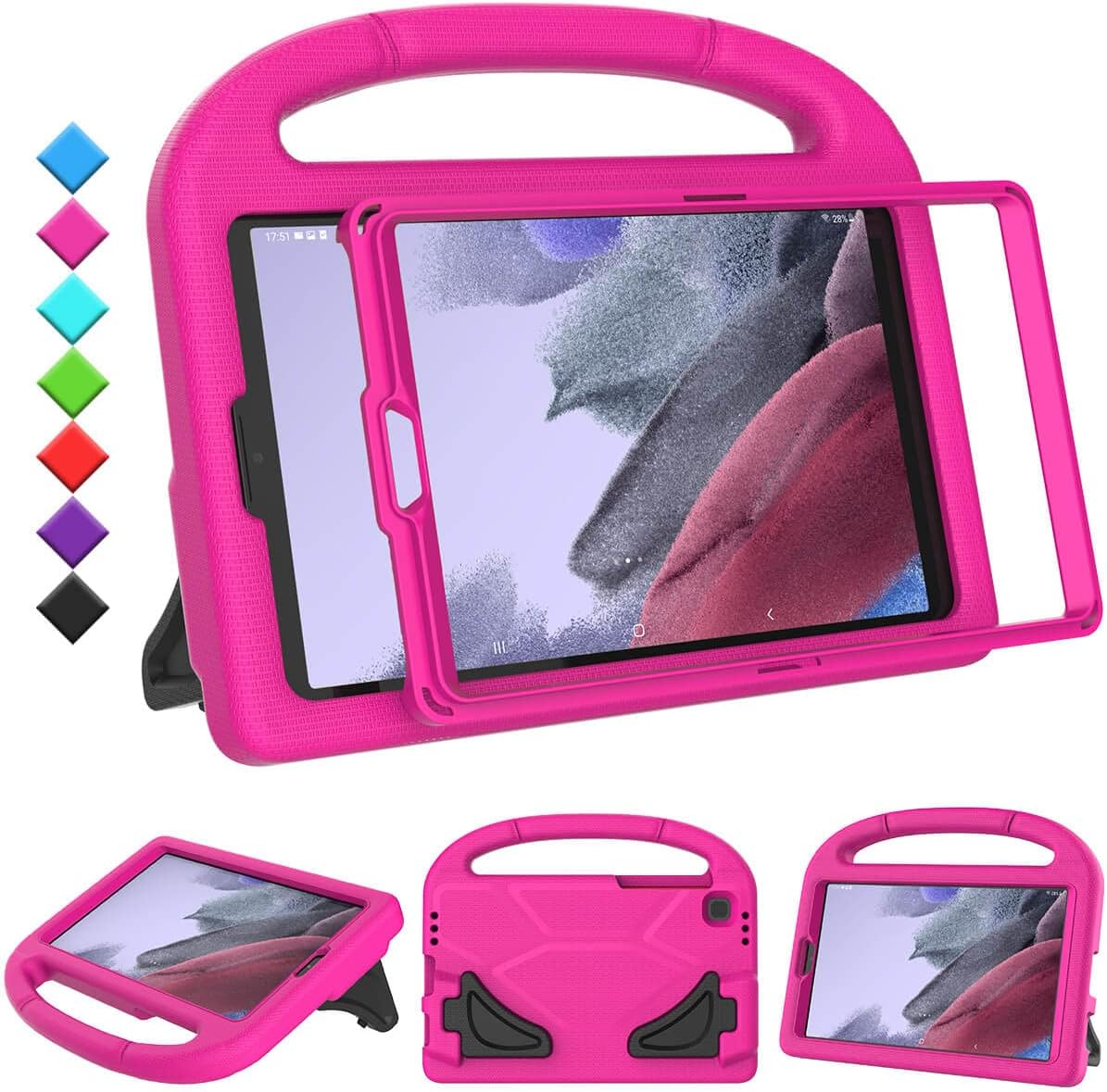
Samsung Galaxy Tab A7 Lite 8.7" 32GB
The A7 Lite is what you buy when "hand it to grandma" means she has to hold it one-handed while stirring pasta. At 8.7 inches it fits a purse, a nightstand drawer, or a car glove box, and the metal back survives real-world bumps. It is the least intimidating tablet in this roundup — no stylus, no keyboard dock, no confusing pro modes.
The trade-off is screen real estate and speaker output. Two people watching a movie on an 8.7-inch screen is cramped, and single speakers get loud but not rich. But as a dedicated video-call device for a grandparent or a first streaming tablet for a child, it earns its 71.6/100. The Vegan and B Corp and FSC certifications place it in the top half of the roundup on ethics.
Pros
- ✅ Compact and one-hand friendly
- ✅ Metal back survives drops
- ✅ Vegan, B Corp, FSC certified
Cons
- ❌ Small for shared movie nights
- ❌ 32GB fills up fast with kids' apps

Raycon Everyday Clip On Earbuds
Clip-on earbuds solve a specific multigenerational problem: they stay put on ears that don't fit traditional tips. If a grandparent has trouble keeping standard in-ear buds seated, or a child finds them uncomfortable, the Raycon Everyday Clip On sidesteps the fit problem entirely by hooking over the ear. The 4.3-star rating is the lowest in this roundup, largely because buyers expect in-ear bass and don't get it.
That said, the open design is exactly why it works in shared homes — you hear the door, the dog, and the kettle. Vegan, Cruelty-Free, and FSC certifications are a plus, and the price tier keeps a spare pair realistic for a coat pocket. If bass matters more than awareness, look elsewhere; if awareness matters more than bass, this is a solid budget option.
Pros
- ✅ Stays on tricky ear shapes
- ✅ Open design keeps you aware
- ✅ Vegan and Cruelty-Free
Cons
- ❌ Weak bass versus in-ear models
- ❌ Lowest rating in this roundup (4.3)

Lenovo Tab M10 Plus (3rd Gen)
The Lenovo Tab M10 Plus (3rd Gen) is the streaming specialist. Its 10.6-inch 2K display is the sharpest screen in this roundup, and it is the tablet most likely to be permanently mounted to a kitchen wall or shared as the household's "TV that moves." At 71.2/100 it lands just behind the Galaxy Tab A9+, but its display quality and speaker separation give it an edge for movie nights.
The reason it ranks second rather than first is software longevity — Lenovo's Android update history is shorter than Samsung's, and a multigenerational household tends to keep devices for four or five years, not eighteen months. If you replace tablets every three years and care most about the screen, it is the better buy. The FSC and Non-GMO certifications are disclosed cleanly on the retail packaging.
Pros
- ✅ Sharpest 2K screen here
- ✅ Best-in-class stereo separation
- ✅ FSC Certified packaging
Cons
- ❌ Shorter Android update runway
- ❌ Accessories cost more than Samsung's

LeapFrog LeapPad Academy Kids' Learning Tablet
Every multigenerational home with a preschooler needs one device that is not a hand-me-down. The LeapPad Academy is built from the ground up for ages 3–7 with a chunky protective bumper, curated app library, and parental dashboard that is genuinely simple to operate. It scores 70.8/100 — the lowest in this roundup — but that reflects a narrower use case rather than weaker execution.
The 4.6-star rating from parents is telling: the target users love it. What holds the score back is the ceiling. Once a child turns eight or nine, the LeapPad Academy feels babyish, and the household has to buy a second device. Plan for a two-year lifespan, hand it down to a younger sibling or cousin, and the per-year cost is very reasonable. Vegan and B Corp certifications align it with families who care about ethics in kids' products.
Pros
- ✅ Genuinely kid-proof design
- ✅ Strong parental controls
- ✅ Vegan + B Corp certified
Cons
- ❌ Short useful lifespan (ages 3–7)
- ❌ Not a device for adults
💡 Pro tip
Put every shared household device on a single Wi-Fi 6 or Wi-Fi 6E router with separate 2.4GHz and 5GHz SSIDs. Older tablets and kids' devices often prefer 2.4GHz, while newer phones and streaming tablets run better on 5GHz. Splitting the bands manually prevents the classic "everything buffers at 7 p.m." problem in a home with five or more connected devices.
⚠️ Watch out
Do not buy a tablet without a case. A $125 tablet without a $20 case is a $145 tablet in eighteen months. For multigenerational homes, buy the rugged case the same day as the tablet, and buy a tempered-glass screen protector at the same time. If the device is headed to a child under eight, add a bumper frame on top of the case.
🛒 How to choose the best Electronics & Tech 2026
Choosing the best Electronics & Tech 2026 for a multigenerational home starts with one honest question: how many people will actually touch this device in a week? A tablet used by one adult can prioritize screen quality and thinness. A tablet used by a child, a parent, and a grandparent has to prioritize durability, text legibility, and setup simplicity — in that order. The devices in this roundup all clear a baseline of shared-use friendliness, which is why their scores cluster in the low-70s rather than spreading wide.
Second, think in terms of total cost of ownership, not sticker price. A tablet that needs a case, a screen protector, a microSD card, and a replacement charger can add $60 to $80 to the initial cost. Add a streaming subscription and you are looking at roughly $45 per year after purchase. Devices with standard USB-C charging, widely available cases, and long software-update windows quietly save hundreds over a four-year ownership period.
Finally, treat audio as a household decision rather than a personal one. In a home where multiple people share space, open-ear designs like the Shokz OpenFit Air 2 and Raycon Everyday Clip On are consistently safer and more considerate than sealed in-ear models. Awareness of the room is a feature, not a compromise — especially when a grandparent might need to be heard from the kitchen while a teenager is on a call in the living room.
- ✅ Prioritize shared-use durability: Look for metal or reinforced backs, chunky bumpers, and tempered-glass compatibility.
- ✅ Check the software-update runway: Four or more years of Android updates matters more in multigenerational homes than in solo homes.
- ✅ Verify certification transparency: FSC, B Corp, Vegan, and Cruelty-Free certifications are checkable claims; vague "green" marketing is not.
- ✅ Budget for accessories on day one: Case, screen protector, spare cable, and one microSD card if the device supports expansion.
- ✅ Choose open-ear audio for shared spaces: Awareness of the room prevents accidents and reduces household friction.
- ✅ Test text scaling before you buy: Open a news site and a video-call app at the same time and check readability at default settings.
A device that three generations can use without a tutorial is worth more than a device that only one generation can unlock.
❓ Frequently Asked Questions
What is the best tablet for kids and grandparents to share?
The Samsung Galaxy Tab A9+ is the best shared tablet for kids and grandparents in 2026 because its 11-inch screen, quad speakers, and native Kids Mode plus Google Family Link support serve both audiences. Grandparents get readable text and a large video-call window; kids get time limits and curated app access. The expandable microSD slot also matters when three people are downloading offline content onto one device.
Are open-ear earbuds good for around the house?
Yes — open-ear earbuds are the best category for around-the-house listening because they keep you aware of doorbells, kids, and conversations while you listen. The Shokz OpenFit Air 2 and Raycon Everyday Clip On both use this design. The trade-off is reduced bass compared to sealed in-ear models, which is a fair price for safety and household awareness.
What is the best budget Android tablet for streaming and video calls?
The Lenovo Tab M10 Plus (3rd Gen) is the best budget Android tablet for streaming and video calls thanks to its 2K display and strong stereo speakers. It is the sharpest screen in this roundup and handles video calls well. If long-term software updates matter more than screen quality, switch to the Samsung Galaxy Tab A9+ instead.
What is the best kids learning tablet with parental controls?
The LeapFrog LeapPad Academy is the best kids learning tablet with parental controls for ages 3 to 7 because it was designed from the ground up for that audience. The bumper, curated app library, and simple parental dashboard are all purpose-built. Expect about a two-year useful lifespan before the child outgrows it.
How do I pick a shared family tablet that lasts?
Pick a shared family tablet by weighing software-update runway, case availability, expandable storage, and standard USB-C charging rather than by raw specs. A tablet with four years of updates, a widely available $20 case, and microSD expansion will outlast a faster tablet with proprietary accessories. Buy the case and screen protector on day one.
Is the Shokz OpenFit Air 2 better than the Raycon Everyday Clip On earbuds?
The Shokz OpenFit Air 2 scores higher at 72.4/100 versus the Raycon Everyday Clip On at 71.6/100, mostly because of its broader certification set and more comfortable long-wear fit. Raycon remains the better pick if ear-shape fit is the deciding factor, since its clip design stays on ears that struggle with standard tips. Both prioritize situational awareness over bass.
🏆 Final verdict
The Samsung Galaxy Tab A9+ is the best Electronics & Tech 2026 pick for most multigenerational homes, and the Lenovo Tab M10 Plus (3rd Gen) is the runner-up for households that stream more than they call. Pair either tablet with the Shokz OpenFit Air 2 for shared-space audio, and use the LeapFrog LeapPad Academy as the dedicated device for the youngest users.
If you are building a three-device household from scratch, start with the Galaxy Tab A9+ and the Shokz OpenFit Air 2 — those two cover roughly 80 percent of shared-home use cases. Add the A7 Lite for a grandparent's bedside or the LeapPad Academy for a preschooler as needs arise, and put the whole setup behind a single well-configured Wi-Fi 6 router. That combination will keep every generation connected without a monthly disaster.